Thursday, December 11, 2014

London IV: "The Square Mile" (30th July-1st August 2014)


The City of London is known as the Square Mile, because it measures 1.12 square miles or 2.9 square kilometres. Before going on further, I must apologize that this photo and the album title is a little misleading.

Let me explain why. Firstly, what I refer to London in this album refers to the capital city as a whole. The Square Mile only refers to the ceremonial county of the City of London. Sounds confusing eh? Secondly, the Big Ben (as seen in the album cover) is not in the City of London but is in the City of Westminster.

Even more confused? Never mind then. Let's see if going around the Capital City of London will clear that up a little.


My Mum with her Little Ben and the Big Ben behind her.

"Big Ben" is actually the nickname of the clock and the tower and not it's actual name. It is known as the "Elizabeth Tower" after it was renamed from "Clock Tower" in 2012 to celebrate Queen Elizabeth II's Diamond Jubilee.


Guess 1 Ben isn't enough in this family ;)

The "Big Ben" Elizabeth Tower is one of the most iconic symbols of the United Kingdom. As such, it is often portrayed in films as the symbolic representation of both London as well as UK as a whole. The 4-faced chiming clock seen on the tower is largest in the world.

In filmmaking context, the Elizabeth Tower is often used as the "establishing shot" to indicate the location of London. The other landmark that often comes hand in hand with it is the London Eye.


Palace of Westminster (check), Elizabeth Tower (check), Westminster Bridge (check), red double-decker bus (check)

This is perhaps the best way to depict London. Only thing missing is a black London cab, although there is a white one just behind the bus.

Just to clear things up again, this is in the City of Westminster, located West of the City of London. The reason why there's confusion is because today's "London" no longer refers to just the "City of London" itself but to the Administrative Region of "Greater London".


People are generally more familiar with the Western façade of the Westminster Abbey because of the Great West Door and the 2 towers. But I'm not one for familiarity so I've chosen the Eastern façade for our photo instead.

There have been 16 Royal Weddings held here. The most recent one being Prince William and Catherine Middleton's (now the Duke and Duchess of Cambridge) in 2011.


Still in the City of Westminster, this is the National Gallery located in Trafalgar Square. Was here for the first time back in March and had the opportunity to go inside to explore the art works. 

Apparently, they weren't as interested as I was in visiting the 4th most visited art gallery in the world (after the Louvre in Paris, the British Museum also in London and the Met in New York). And I thought I was coming here for the second time...


Now we're in the City of London. Already got the key shots of St. Paul's the last time I was here, so I wanted something different. This was taken along Peter's Hill towards the Millennium Bridge.

The City of London consists of other major landmarks including the Monument to commemorate the Great Fire of London, the Bank of England and 30 St Mary Axe (better known as the Gherkin), all of which are not featured in this album.
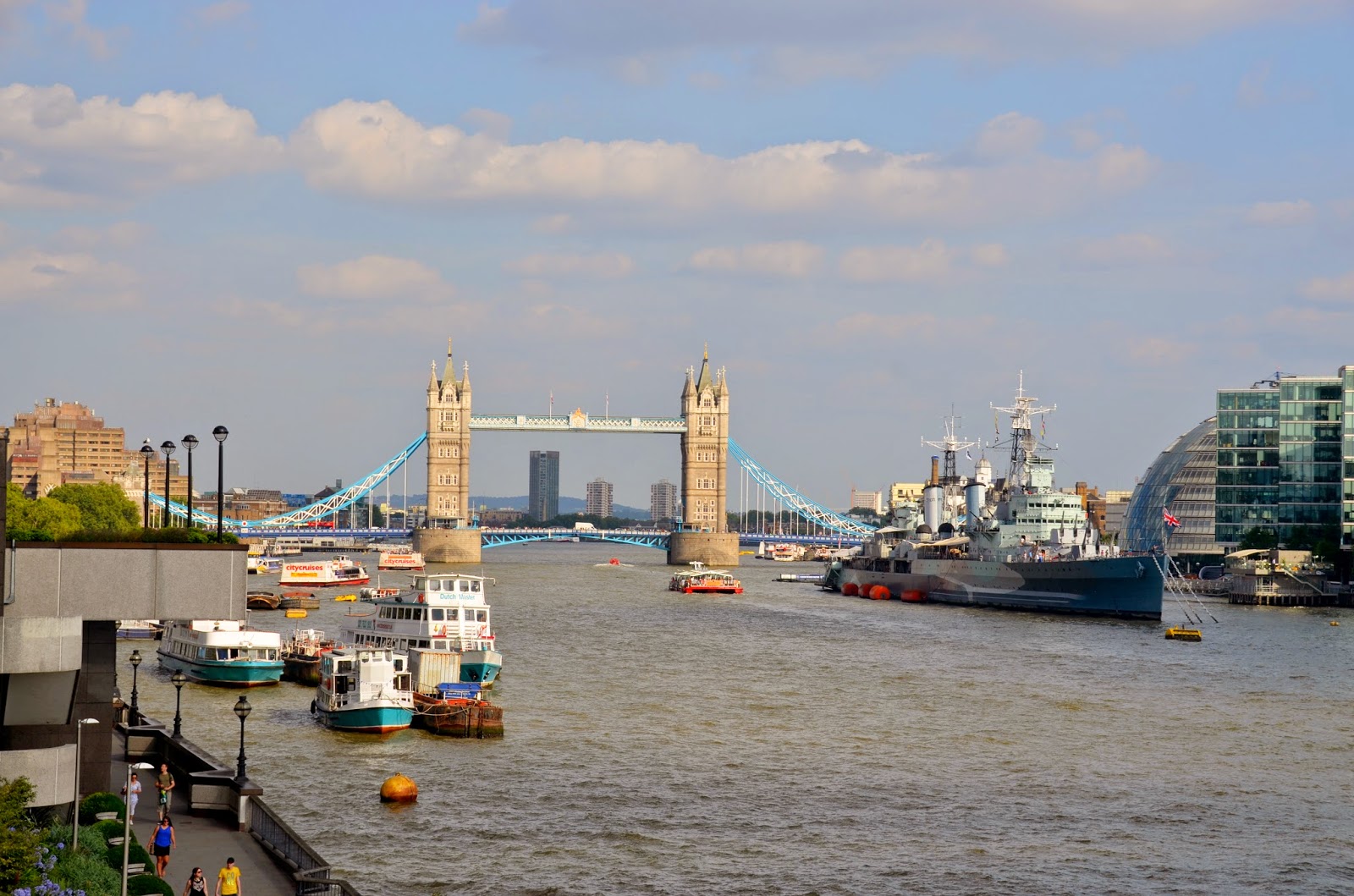

That's the Tower Bridge you see in the distance along with the HMS Belfast (which houses the Imperial War Museum).

No, that is NOT the London Bridge because this photo was taken while on the London Bridge itself. There's no confusion here alright. People often mistake the Tower Bridge as the London Bridge when it's 2 completely different bridges.

Never knew this? Well, now you do! (Even though you're supposed to know this if you've seen London Town from March earlier).


Here it is "closer-up". The Tower Bridge. It links the London Boroughs of Tower Hamlets and Southwark. Tower Hamlets is where the Tower of London is and Southwark is where you'll find Tate Modern and the Shard.


The beautiful glow of the evening sun!


The Royal Standard, seen at the top of one of the smaller towers in the Tower of London.


Still fascinated by Boris Johnson's office it seems. Also located in Southwark, this is City Hall, the headquarters of the Greater London Authority (GLA) which was established in 2000.

According to Fosters and Partners, the architecture firm behind its building and construction, City Hall's peculiar shape was meant to improve energy efficiency. This is widely disputed because it's almost entirely made of glass and measurements recorded seemed to prove otherwise.


The Tower of London belongs to the London Borough of Tower Hamlets and is just outside the City of London. I suppose you could say that Tower Hill is the distinguishing line.

The red poppies commemorating the 100th year since the 1st World War were already beginning to fill up the place.

The Tower of London has been listed as a UNESCO World Heritage Site since 1988.


A solitary Queen's Guard marching at the Buckingham Palace. Also located in the City of Westminster, it is the London residence of the monarchs of the UK.


The Victoria Memorial in front of Buckingham Palace at the centre of Queen's Gardens. It is dedicated to Queen Victoria. A similar memorial, that I would visit 2 days later, is one of Prince Albert, Queen Victoria's husband, is found in Kensington Gardens.


With the Buckingham Palace in the background, and a friend who just happened to walk by.

It's a little bit like the Istana, if you put it into Singapore context. It takes £15 million to maintain the palace on a yearly basis. That is really quite extraordinary! I suppose you could buy an Ángel Di Maria if you don't maintain it for 4 years...


That was it for the day tour so it was time to settle home for some home-cooked Singapore food. Was great to have my buddy around to savour the good stuff!


After returning from Manchester and arriving at King's Cross Station. Everybody comes to Platform 9 and 3/4 to see if they can cross into the magical world. But I know I'm no Wizard, so I just couldn't be bothered to try.


My little sister doesn't seem very interested to try either. Proud to be a Muggle then! ;)


Into the final full day in London and I found myself in South Kensington... Here's the Queen's Tower, located in the campus of the Imperial College of London. If you take all 325 steps up to the top, you'll get the beautiful view of West London from all sides.


The Legendary Royal Albert Hall! One of the UK's most treasured buildings for performing arts. Performing here is a dream come true for any artist and more so if they're form the UK.

My favourite recent performance here is most definitely the one from Adele in 2011, where her live rendition of "Set Fire to the Rain" won her a 9th Grammy in 2013. She's already into double figures after winning her 10th for Skyfall earlier this year!


The Albert Memorial, first mentioned earlier together with The Victoria Memorial. Found in Kensington Gardens, this memorial was commissioned by Queen Victoria in memory of her husband, Prince Albert.

It might not be very clear, but the words on the canopy above Prince Albert's statue says "Queen Victoria and Her People". The full legend, if you put all 4 sides together says "Queen Victoria And Her People • To The Memory Of Albert Prince Consort • As A Tribute Of Their Gratitude • For A Life Devoted to the Public Good."


It's funny how I choose a lake as the final photo for London (and chronologically for the entire trip). I figure you don't always have to go out spectacularly. But maybe I'll leave that to the last 2 albums in Manchester and Greater Manchester.

This is it then... Chronologically, the final photo of this part of my story album, this is the Serpentine. Found in Hyde Park, this curving lake (which only has one bend) is the divide between Hyde Park and Kensington Gardens.

Then, it was time to head to Heathrow on an A380 homebound to celebrate National Day before going outbound again!

Bucharest București: Little Paris / Pleven Плевен (22nd-23rd July 2014)


Most people want to go to the City of Lights. To see the Eiffel Tower, the Arc de Triomphe, the Louvre, the Notre-Dame de Paris, among other famous Parisan landmarks. While I do have some regrets over not going to Paris, I'm happy enough to visit Little Paris!

Bucharest București, is the capital of Romania and earned it's nickname because of the city's architecture and the elite and high life reputation it has. It even has its own Triumphal Arch (Arcul de Triumf). Unfortunately, it was under renovation and I was not about to post another photo of a piece of cloth again.

There were lots of delays along the way into Bucharest and it meant there was no time to explore much. But when you're travelling in a race against time, you take what you can get.

Seen here is the Romanian Athenaeum which is among the iconic landmarks of the city. More about it when we get there again.


Still on the Danube Bridge but entering the Romanian half of it before driving straight through Giurgiu and onwards to Bucharest.


Staying along Bulevardul Unirii had one single benefit and that was to be able to see the Parliamentary Palace of Romania in full view.

This massive palace houses both chambers of the Romanian Parliament and serves several purposes. It holds a number of records including Most Expensive Administrative Building, World's Parliament Building and Heaviest Building. The neoclassical palace was completed in 1997, having taken 13 years to build and costing a whopping 3 million €uros!


Not necessarily the symbol of Calea Victorilei but it is certainly distinctive enough to immediately tell anyone who's been to Romania that you are along Victory Avenue. Besides being the avenue where most of the landmarks were, it also houses multiple luxury brands, which I had no money to bother and clearly no interest in seeing.


Located opposite the National Museum of Romanian History is the eclectic-styled CEC Palace. CEC stands for Casa de Economii şi Consemnaţiuni, the state-owned bank.

The dome at the top of the palace is quite unique in that its made of both glass and metal. The domes at the 4 corners are Renaissance domes that do not resemble the one on the top. The front entrance has an arch that ends with a twin of columns.


Located diagonally opposite the CEC Palace, is the Zlătari Church (Biserica Zlătari), an Orthodox church that has been listed in Bucharest's Historical Monuments list. I reckon it's not easy to miss because it stands out from all the commercial buildings surrounding it.


Going further down Calea Victorilei, you'll see the Cercul Militar Naţional. It translates to Palace of National Military Circle. It houses the National Military Library as well as the headquarters to the National Military Circle (the Romanian Army's cultural institution).

This architectural beauty is unmissable and is yet another iconic landmark of Bucharest. The eclectic style is seen clearly in the twin columns at the front of the building. It was believed to be the most beautiful and most impressive palaces built back then. Maybe that's why they needed to up the stakes for the Parliamentary Palace.


It's a long avenue... And after Bucharest's Odeon Theatre, you'll see a very unique church called the Kretzulescu Church (Biserica Crețulescu). It's just beside the Royal Palace next door and the Palace Hall. Incidentally, Julio Iglesias was in town for a big concert at the Palace Hall that night. Pity there weren't any tickets left.

The Brâncovenesc style that it is built in is a hybrid of 4 different styles, namely Baroque, Byzantine, late Renaissance and some Ottoman influence.

Also seen here is a memorial bust of Corneliu Coposu, identified by locals as one of the "greatest Romanians of all time".


The Central University Library of Bucharest (Biblioteca Centrală Universitară) with King Carol I's statue. He was the one who declared Romania as a sovereign country after the Russo-Turkish War, although it must be noted that he was not King yet at that time. Another interesting fact that links back to the time I was at Burg Hohenzollern in Germany, Carol I was also the "founder" of the Romanian branch of the House of Hohenzollern-Sigmaringen.

Located opposite the library is the Royal Palace/Romanian National Art Museum.


The Palatul Regal (Royal Palace). Probably didn't do justice to the palace with this photo but I was kinda limited because the roads were in a mess and there was no way to get a good shot of the Palace so this was the best I could get.

The neoclassical styled palace was home to the monarch until 1947. The last king, King Mihai led a coup from inside here against the pro-Nazi government during WWII. It is now the Romanian National Art Museum, while the Palace Hall at the back is used for performances (like the one by Julio Iglesias that night).


Here we are, at the Romanian Athenaeum (Ateneul Roman). Built by French architect Albert Galleron, the Athenaeum is famous for being funded by the public, through the "Give a penny for the Athenaeum" campaign. It was built with a high dome 6 distinct Doric columns at the entrance.


This Neo-Classical and Romantic-styled beauty is the iconic symbol of not just Bucharest but Romania as a whole. It is the home of the Romanian George Enescu Philharmonic and is widely regarded as one of the best concert halls in the world with world-class acoustics.


The Headquarters to the National Bank of Romania, the central bank of Romania. The equivalent of the Federal Reserves in the US, Bank of England in the UK and the Monetary Authority of Singapore. It issues the Romanian currency, leu and manages both the national reserves and the exchange rate.


The signature Citrus Lemondade at Caru' cu Bere. They describe themselves as "a true living legend and one of the oldest breweries of Bucharest". It was jam-packed with people, but I still managed to get everyone in for dinner ;)


Back at the Parliamentary Palace where it's illuminated by the night lights. The darkness at night doesn't make it any smaller because it's still huge! I think they've got to have employed some of Romania's best builders to finish this giant.


The Village Museum is an ethnographic museum much like Etara in Gabrovo, Bulgaria. Drove by here after seeing the Triumphal Arch covered in cloth. I guess one ethnographic museum was enough.

Headed back to Bulgaria, towards Pleven...


Needed to rush back to Bulgaria for the night because we were staying in Pleven so that we could be closer to Sofia...

Power plants in Ruse on the way across the Danube Bridge.


Through the Bulgarian border and en route to Pleven.


Pleven was more of a stopover before we headed back to Sofia. Figured that it was the right thing to do though because a direct drive from Bucharest to Sofia would have been impossible.

The one thing I remember clearly from Pleven was the place we stayed in. It was right in the middle of Kaylaka which to us, meant in the middle of nowhere. We experienced yet another episode of Bulgarian helpfulness and friendliness in the best possible way!


While searching for our home for the evening among the Kaylaka Nature Park, we got to meet this incredibly friendly and helpful Bulgarian man. Even though he couldn't understand a single thing we said but did us a favour by driving us through the trees to get us to our place for the night. He was only supposed to pick up his wife after work but took a 30 minute detour, just for us. Thank God for sending us this guardian angel!


This was next morning on the way out of Pleven and to Sofia. Somewhere near the town hall I believe. Honestly, I wouldn't consider myself as having been in Pleven cos it was just a rest up for what was to come.

I was initially supposed to join the rest to bring them up to Slovakia and Czech Republic but there were some complications. So I had to meet them in London on the 30th, almost a full week later!

Ruse Русе: Little Vienna (22nd July 2014)


#5 in the "largest city in Bulgaria" list, Ruse is in northeastern Bulgaria (think Punggol in Singapore). Nicknamed "Little Vienna", it lies on the right bank of the Danube River where the left bank is Giurgiu (75km from Bucharest), Romania.

Ruse was just a quick stopover point before crossing the Danube and the Ruse-Giurgiu Friendship Bridge into Romania to get to Bucharest for just one night.

Featured in the album cover is the Pantheon of National Revival Heroes. It honours the Bulgarians who volunteered during the Russo-Turkish War, those who fought for Bulgaria's liberation, educators, cultural activists and basically those who fought and/or sacrificed themselves for the freedom of Bulgaria.


Taken at the banks of Danube, looking across to Romania. Nothing spectacular about this but it was especially significant to me because it is here where the Danube passes through the 6th and 7th (out of 10) countries I've been to. There's still Serbia, Ukraine and Moldova left to go, but that will have to wait...


Ruse is among a unique list of 6 other cities that have been called "Little Vienna". The Neo-Baroque and Neo-Rococo buildings around the city (especially near Freedom Square) do remind you a bit of Vienna.

None more so than Dohodno Zdanie which you can see in the background on the right here. It literally means "profitable building". It was built to provide funds for the school board through the library, theatre, casino and shops built into it. It is regarded as one of the significant landmarks in Ruse. So I'm a little disappointed that I didn't have time to go in.

You'll also see The Monument of Liberty here, but a bit of that in just a while.


My obsession with statued lions remain. Standing on either side of the monument are a pair of Bulgarian lions, one guarding the Shield of Freedom and this one, biting on some chains. Presumably, it means liberation. In the background is the съдебна палата sudebna palata, Court House of Ruse.


The Monument of Liberty is the symbol of Ruse and is also present in its Coat of Arms. Built by Italian Arnoldo Zocchi, the lady standing on the pedestal, carries a sword on her left hand while pointing, with her right hand, in the direction of where the liberators first arrived into Bulgaria.


Heading towards the Danube Bridge, which connects the Bulgaria and Romania over the Danube. It was previously known as the Friendship Bridge during the communist regimes and was built with the help of the Soviets between 1952 and 1954. Both years are inscribed into the 2 pillars just before you get on the bridge itself.


Crossing over to Romania on the Danube Bridge and needing to get through border control because both countries have yet to enter the Schengen Agreement.

This agreement was created in 1995 and has since allowed for a borderless Schengen Area in many countries in Europe. It is a crucial portion of EU Law and as such all EU nations are legally obliged to join the agreement, except for the 2 opt-outs, the UK and Ireland.